Intelligence? (D4)
Technology is now a dominant driver of many business strategies, especially "Artificial Intelligence" (AI). Is this wise? Is it not now time for business strategy to grab the initiative and drive technology development and its applications?
25 years ago, "knowledge management" was the rage. Clearly a misnomer, but a new buzz phrase seized upon by the software giants keen to apply further their data base management systems as knowledge depositaries. The focus was on data: whereas a more informed choice was to identify and record those people who knew things and whose wisdom could be tapped to navigate nuanced variations of deceptively similar situations.
To that end, communities of practice (COPs) of various types emerged to harness the interests and capabilities of individuals [1] and pioneers in making sense of knowledge "management" guided us [2].
Even then, it was recognised that the collaborative interactions between participants was crucial. This was represented as informal networks weaving between the formal processes of any enterprise...a phenomenon which VES can easily model.
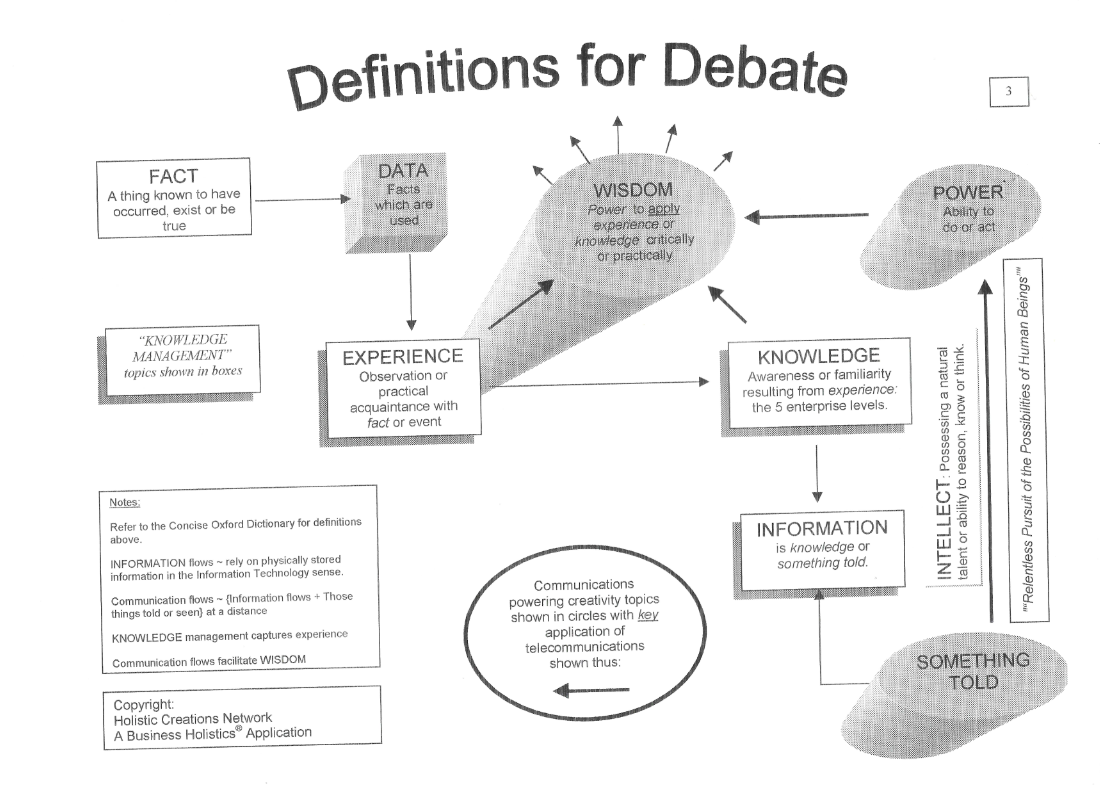
Hence, 25 years ago, serious attempts were made to shrug of the tentacles of technology pushers and step back to appraise fundamentals. One of my contributions was entitled "Definitions for Debate." I invite readers to download and distribute this chart to colleagues as they ponder the notion of Artificial Intelligence. What is it, really?
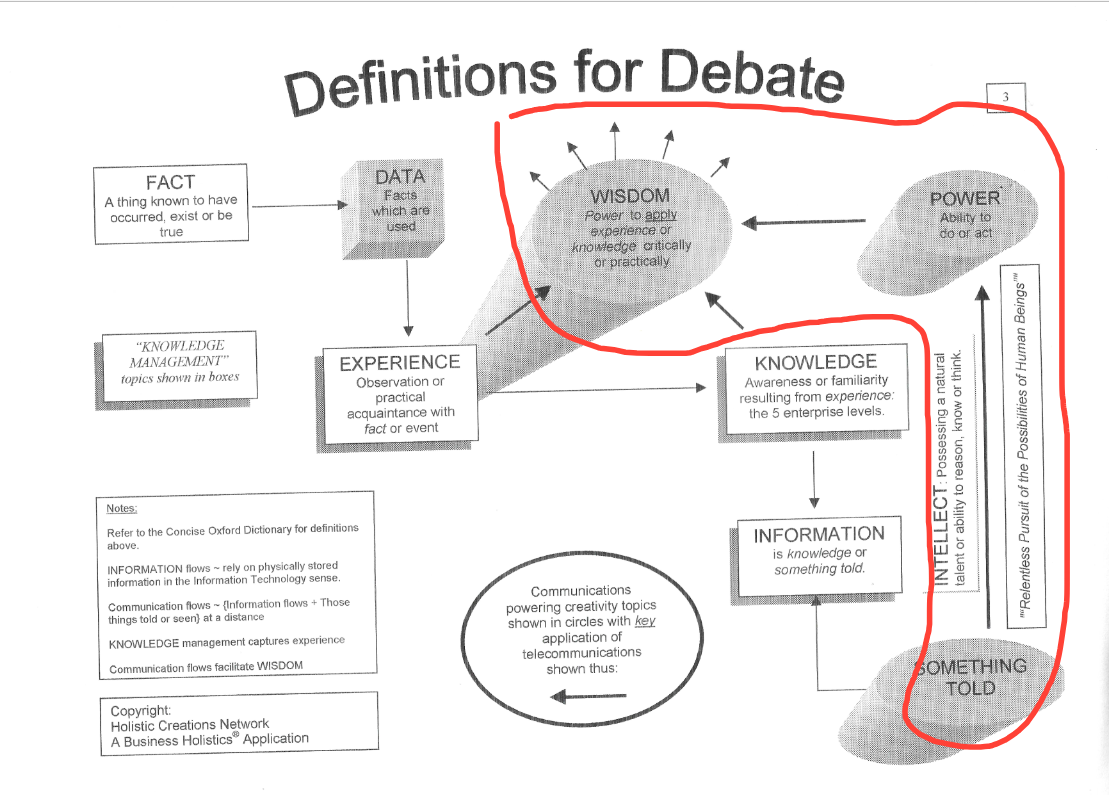
Why not start with the items encircled red?
Note that Intelligence is the Intellect / understanding of a person or animals quickness of understanding / wisdom: or an intelligent or rational being.
Where do algorithms fit in?
Recap that humans interact, with feelings and emotion, and that Intelligence is a core subsystem for assessing an enterprise viability.
Superintelligence is dangerous not because it thinks better than us, but because it doesn't think at all — yet we will increasingly act as though it does. The definition of intelligence requires wisdom and understanding; superintelligence delivers neither, only velocity and volume. The enterprise risk is not AI rebellion; it is AI deference — humans abdicating judgement to systems incapable of holding it.
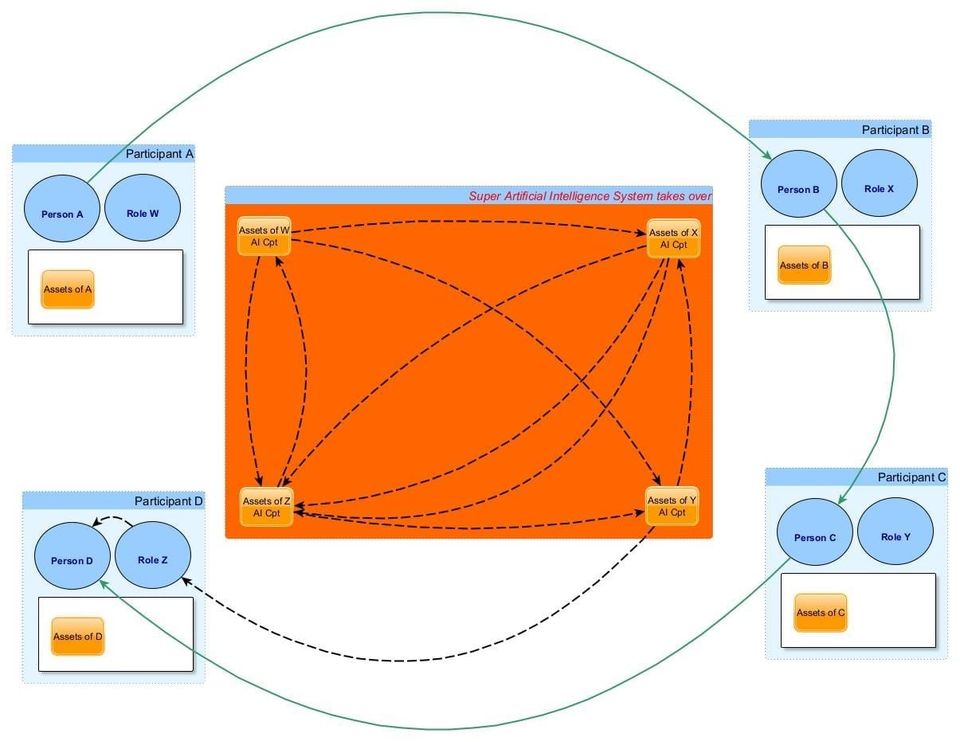
As to the future: "superintelligence," driven by AI algorithmic advances and quantum computing WILL pose a huge threat to the control humans have over their destiny. It is easy to demonstrate this for an enterprise using VES and will feature in a Summer post in the VES Intelligence store... Now appearing as (D8).
The definition above is instructive when applied to superintelligence. Intelligence belongs to persons and animals — it carries quickness of understanding, wisdom, and rational agency. Algorithms possess none of these: they match patterns at speed; they do not understand.
The danger of superintelligence, therefore, is not that it will one day think better than us. It is that it will be treated as if it does — while actually being something categorically different. As algorithmic advances combine with quantum computing, decision-making authority will migrate to systems that lack wisdom, lack genuine understanding, and have no stake in human destiny.
Again, enterprise risk is not rebellion; it is deference — humans abdicating judgement to systems incapable of holding it. Intelligence, as defined here, is a core subsystem of any viable enterprise. Viability is hollowed out from within by something that only mimics its outputs: viability is compromised from within.
Business strategy must therefore seize the initiative — not merely accommodating AI as a given, but interrogating it against the standards that matter: understanding, wisdom, and the irreducibly human capacity to navigate situations that deceptively resemble ones we have seen before.
[1] E. Wenger, Communities of Practice - Learning, Meaning, and Identity, Cambridge: Cambridge University Press, 1998.
[2] Some examples are: Karl-Eric Sveiby, Hubert Saint-Onge, Verna Allee, Etienne Wenger, George Por, Charles Savage and Leif Edvinsson.